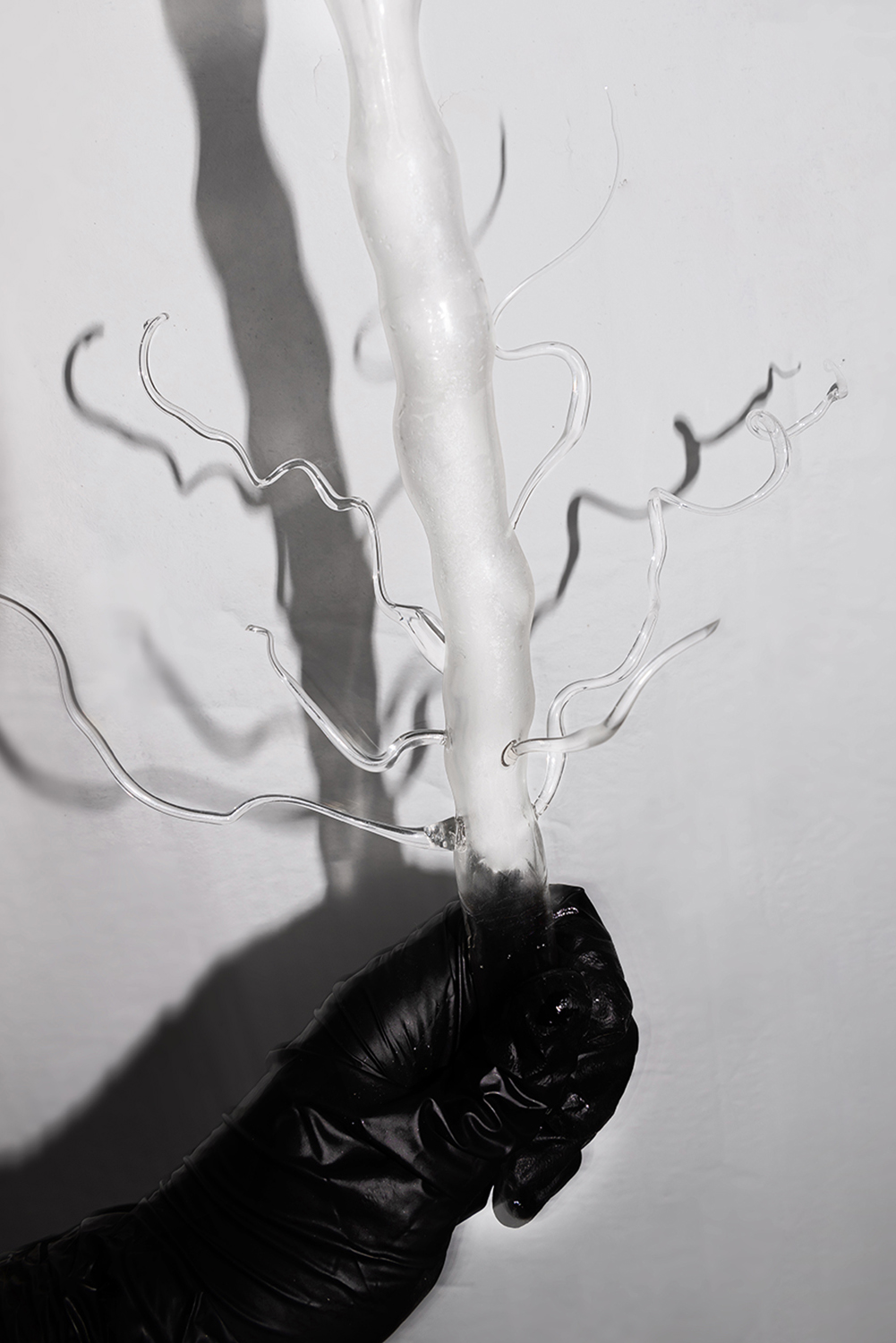
Pyrosoma Atlanticum
(Rodillo de Fuego).
Barcelona, 2022.


28 x 18 x 73 cm
Glass, Gypsum and LED light.
Price upon Request

The Pyrosoma Atlanticum is made up of several tiny individuals forming a closed tube at one end. Each individual filters the water in search of plankton. The inhaling openings are external and the exhaling openings pour into the tube, creating a jet that propels the colony through the water.

The glass maintains the same cylindrical and vertical shape that the "Fire Roller" also presents and, furthermore, this is formed through the union of two separate pieces, thus relating to the concept of a set of elements that end up forming one structure. On the inside it lights up as the Pyrosoma Atlanticum, which it presents a strong greenish-yellow (bacterial) bioluminescence that can only be seen at night.

파이로소마 대서양  (로딜로 데 푸에고).

바르셀로나, 2022.
28 x 18 x 73 cm.
유리, 석고 및 LED 조명.

요청 시 가격 문의.

파이로소마 대서양은 한쪽 끝이 닫힌 튜브를 형성하는 여러 개의 작은 개체로 구성되어 있어요. 각 개체는 플랑크톤을 찾기 위해 물을 여과합니다. 흡입구는 외부에 있고 내뿜는 구멍은 튜브로 쏟아져 식민지를 물을 통해 추진하는 제트를 생성하며 유리는 "파이어 롤러"와 동일한 원통형 및 수직 모양을 유지하며, 또한 두 개의 개별 조각의 결합을 통해 형성되므로 결국 하나의 구조를 형성하는 요소 집합의 개념과 관련이 있습니다. 내부에서는 밤에만 볼 수 있는 강한 녹황색(박테리아) 생물 발광을 나타내는 파이로소마 아틀란티쿰(Pyrosoma Atlanticum)으로 불이 켜집니다.


Biography


Josep Plaja (Girona, 1996) is a contemporary designer based between Barcelona and the Costa Brava whose work focuses on the study of glass and light through biomimicry. Inspired by bioluminescent animals from the seabed, Plaja combines an aesthetic centred on shape, the rawness of materials, and the relationships established between them.

Graduated in Audiovisuals and Multimedia at the University of Girona / EU ERAM and later completed a Master’s degree in Exhibition Space Design at the Polytechnic University of Catalonia in collaboration with the CCCB.

His work centres on exploring the relationship between light and glass, finding inspiration in bioluminescent creatures and using their natural radiance as a basis for his designs, represented in an abstract and evocative way. Moreover, his creative process emphasises the versatility of materials, allowing each collection and project to adapt to its concept and production environment. This approach not only deepens the connection between the artwork and its place of production, but also encourages new relationships between glass and other refined materials—expanding the possibilities of form, texture, and material interaction while remaining open to both traditional and innovative production methods.

His pieces generate a dialogue between the object and the viewer, attempting to turn the latter into their own prey, much like bioluminescent animals use light to attract and hunt. The attraction generated by light, contrasted with the aggressiveness and fragility of glass, creates a parallel with these creatures that are beautiful yet dangerous at the same time. Through this tension, Plaja reflects on those toxic elements that seduce us purely through their beauty.