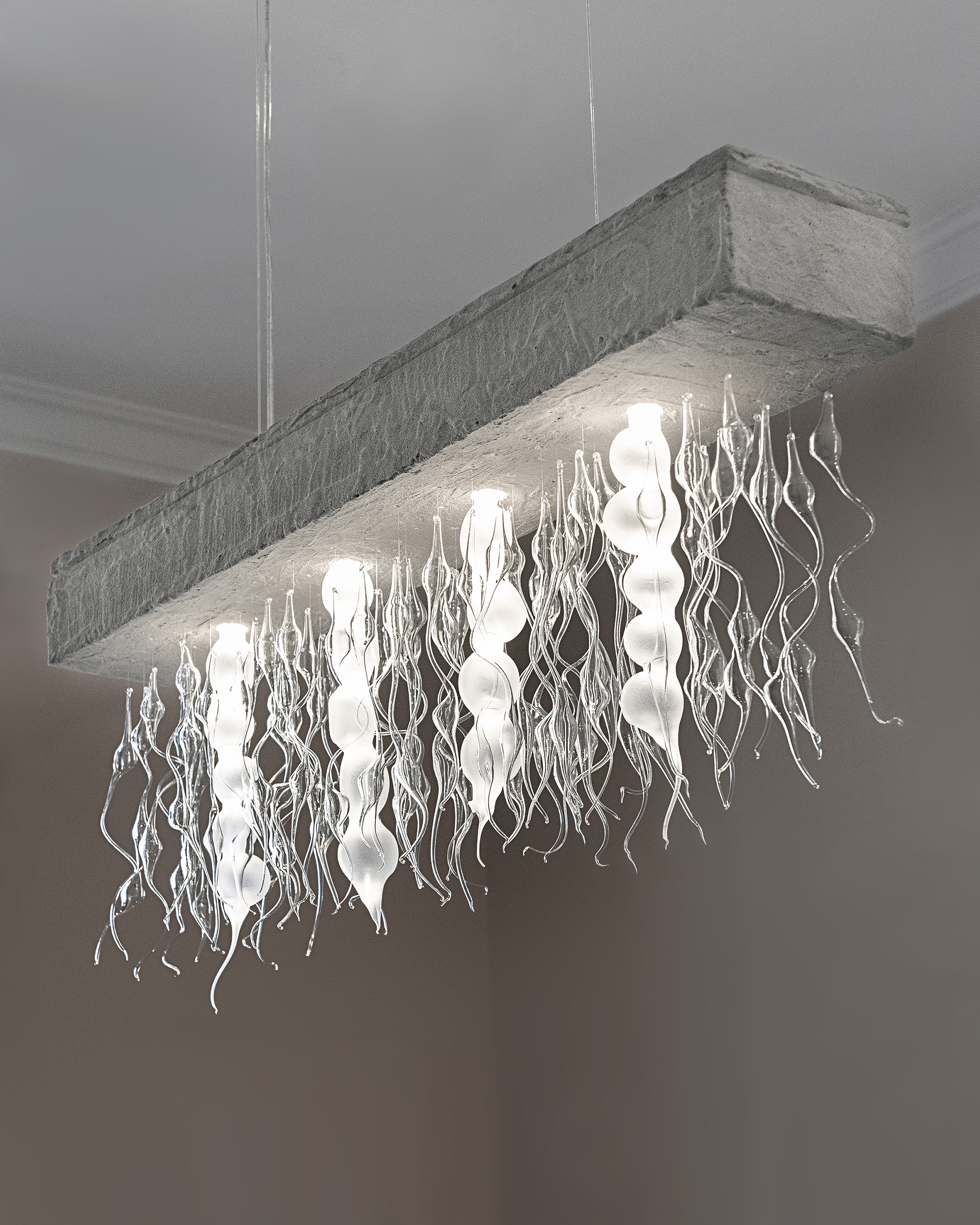
Pelagia Noctiluca II (Clavel de Mar II). 2023, Barcelona.


90 x 15 x 39 cm

Glass, Concrete and LED light.

Price upon request.

Its scientific name (Noctiluca) refers to the fact that this species glows in the dark. When it is excited, a short luminescence is produced that leaves a trail behind and fades little by little. It can form blooms of hundreds of thousands of individuals that usually wash up on the beaches. It is the most common species in the Mediterranean. Its sting causes discomfort as a burn and only deep irritation occurs.

As its a piece produced under comission, the rectangular and geometric shape of the cement base refers to the domestic space in which it was to be installed, designed to fit on top of a rectangular dining table.

펠라기아 녹틸루카 II (클라벨 데 마르 II).

2023, 바르셀로나.

90 x 15 x 39 cm

유리, 콘크리트 및 LED 조명.

요청 시 가격.

학명(녹틸루카)은 이 종이 어둠 속에서 빛난다는 사실에서 유래했습니다. 흥분하면 짧은 발광이 생성되어 흔적을 남기고 조금씩 사라집니다. 일반적으로 해변에 수십만 마리의 꽃을 형성 할 수 있습니다. 지중해에서 가장 흔한 종입니다. 쏘이면 화상으로 불편함을 느끼며 깊은 자극만 발생하며, 시멘트 베이스의 직사각형과 기하학적 모양은 직사각형 식탁 위에 놓을 수 있도록 설계된 설치 공간에 맞게 제작되었습니다.


Biography


Josep Plaja (Girona, 1996) is a contemporary designer based between Barcelona and the Costa Brava whose work focuses on the study of glass and light through biomimicry. Inspired by bioluminescent animals from the seabed, Plaja combines an aesthetic centred on shape, the rawness of materials, and the relationships established between them.

Graduated in Audiovisuals and Multimedia at the University of Girona / EU ERAM and later completed a Master’s degree in Exhibition Space Design at the Polytechnic University of Catalonia in collaboration with the CCCB.

His work centres on exploring the relationship between light and glass, finding inspiration in bioluminescent creatures and using their natural radiance as a basis for his designs, represented in an abstract and evocative way. Moreover, his creative process emphasises the versatility of materials, allowing each collection and project to adapt to its concept and production environment. This approach not only deepens the connection between the artwork and its place of production, but also encourages new relationships between glass and other refined materials—expanding the possibilities of form, texture, and material interaction while remaining open to both traditional and innovative production methods.

His pieces generate a dialogue between the object and the viewer, attempting to turn the latter into their own prey, much like bioluminescent animals use light to attract and hunt. The attraction generated by light, contrasted with the aggressiveness and fragility of glass, creates a parallel with these creatures that are beautiful yet dangerous at the same time. Through this tension, Plaja reflects on those toxic elements that seduce us purely through their beauty.